
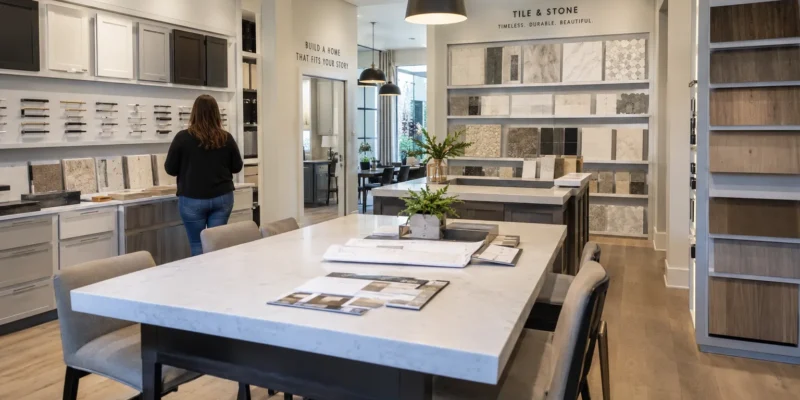
New construction buyers usually discover the hidden costs of building new mid-decision—standing in a design center with forty tile samples in front of them. Some buyers love that moment. For some families, it’s the opposite: the budget starts moving, the decisions pile up, and the home that was supposed to feel exciting starts to feel like a job.
Knowing which one actually fits your family before you start touring communities can save real time—and often real money.
Two Ways Builders Price a Home
Base Price Plus Upgrades
The advertised price gets you the home in its simplest form. Everything else—flooring, countertops, fixtures, and trim packages—gets chosen and priced separately in the design center.
This is where buyers can genuinely customize a home to their taste. It’s also where budgets quietly grow, sometimes by tens of thousands of dollars, one selection at a time.
Inclusive Pricing
The price on the sign is close to the price at closing. Finishes, fixtures, and standard features are already built in at a level most buyers would otherwise pay extra for elsewhere.
There’s a small, curated handful of choices rather than an open-ended list—and that’s the entire point. You’re buying a home where the decisions have already been made well, not a blank canvas you have to fill in yourself.
Lennar is one of the builders leaning into this approach in Northeast Florida right now. After touring several of their homes, it’s worth explaining why that matters for certain families specifically—not just as a builder feature.
The Two Things That Actually Matter: Budget and Decisions
Budget Certainty
With inclusive pricing, the number you’re quoted is close to the number you’ll pay. There’s no thirty-thousand-dollar walk through the design center waiting to happen.
For a family working with a defined budget, that predictability is worth something concrete—not just convenience.
Decision Certainty
A handful of well-chosen options replaces dozens of individual selections. That’s not a lesser home. It’s a home where someone has already made the good choices for you: the finishes, the layout logic, and the standard features that would otherwise be upgrades elsewhere.
Families who don’t want to spend six design appointments picking cabinet pulls and tile grout end up with a fully finished, full-featured home anyway.
Put together, those two things mean a family can walk into a master-planned community, tour a model, and reasonably know both what they’re getting and what it costs—without a drawn-out back-and-forth over selections.
This Doesn’t Mean a Smaller Home or Fewer Amenities
Inclusive pricing is a pricing structure, not a downgrade. Homes built this way still sit inside the same master-planned communities, with the same amenity centers, trails, and neighborhood infrastructure as any other home in the plan.
A family choosing the inclusive path isn’t trading away the community experience. They’re trading away the upgrade maze.
Where to See This in Person in Northeast Florida
Silverleaf, in northern St. Johns County, is a good example of a community where multiple builders and pricing philosophies exist side by side.
Within it, Silver Falls and Silver Meadows are both Lennar communities built on the inclusive pricing model. That makes them worth touring back to back with a builder taking the traditional upgrade path, just to feel the difference in person.
Nothing explains the difference better than standing in two model homes on the same afternoon.
The One Thing Worth Doing Before You Tour Either Kind
Whichever approach fits your family, register your own representation before your first visit to any model home. Builder sales staff represent the builder. An independent agent represents you—whether you’re comparing inclusive pricing or negotiating upgrade credits—and in Florida, it typically costs the buyer nothing.
Ready to Compare Communities in Person?
Contact Red Door Realty Group to set up a tour that puts both pricing styles side by side.
Call: (904) 574-4263